



.jpg)
.jpg)
.jpg)
.jpg)
.jpg)
.jpg)


.jpg)

.jpg)
.jpg)

.jpg)


.jpg)
.jpg)
.jpg)
.jpg)
.jpg)
.jpg)
.jpg)
.jpg)
.jpg)
.jpg)
.jpg)
.jpg)
.jpg)
.jpg)
.jpg)
.jpg)
.jpg)
.jpg)
.jpg)
.jpg)
.jpg)


The Country
Namibia Safari Guide
Namibia is one of Africa’s most visually arresting destinations: a place of red dunes, empty coastlines, desert-adapted wildlife and immense, soul-clearing horizons. It is less about dense safari in the classic East or Southern African sense and more about landscapes, mood and the extraordinary beauty of space. Here, travel itself becomes part of the experience — long roads, private concessions, fly-in lodges and ever-changing scenery that moves from ocean fog to ochre sand, canyon country and wildlife-rich plains.
For high-end travellers, Namibia excels in contrast. It pairs beautifully with Botswana or Cape Town, but it is also a destination that easily stands on its own. A well-planned itinerary can include the sculptural dunes of Sossusvlei, rhino tracking in Damaraland, classic game viewing in Etosha and remote luxury on the Skeleton Coast. It is a superb choice for honeymooners, photographers, families with older children, and anyone drawn to design, stillness and extraordinary natural drama.
Where to go
Explore Namibia
Sossusvlei
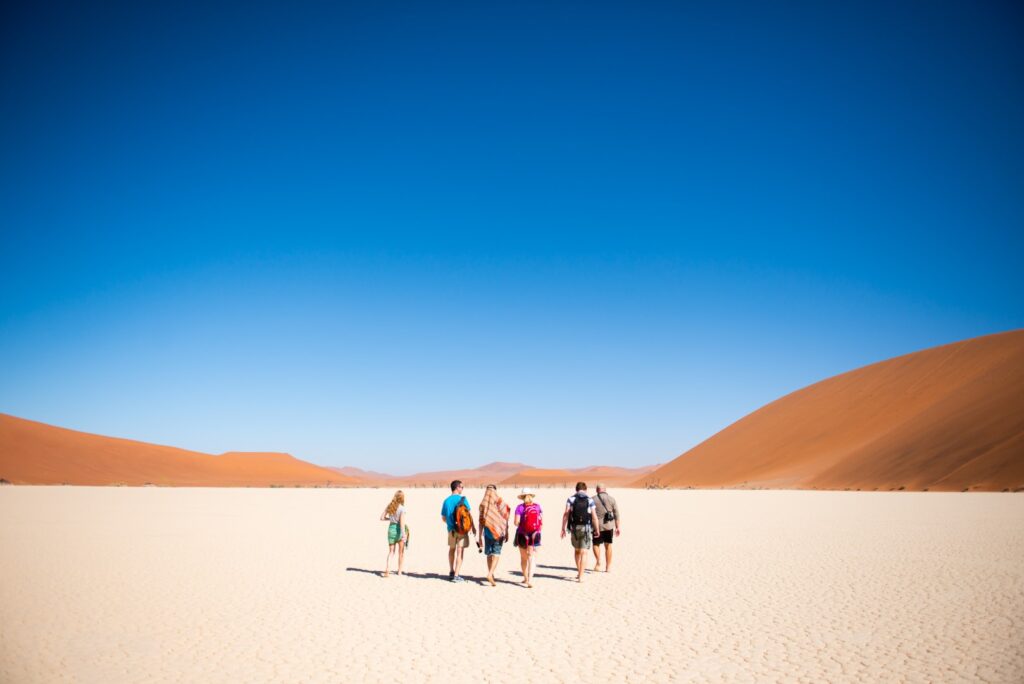
Sossusvlei is Namibia’s most iconic landscape: a surreal world of towering red dunes, bleached pans and dead camelthorn trees set against an intensely blue sky. It is a destination of light and form, best experienced early and late in the day when shadows carve the dunes into perfect lines.
Skeleton Coast
The Skeleton Coast is one of Africa’s most mythic landscapes — a place of sea fog, wrecked ships, wind-shaped dunes and vast coastal emptiness. It is not a destination defined by conventional game viewing, but by atmosphere, remoteness and the romance of the edge of the world.
Etosha National Park
Etosha is Namibia’s classic safari region and one of Southern Africa’s finest parks for dry-season wildlife viewing. Its great white pan creates a unique sense of space and brightness, while the waterholes around its edges draw a wide range of animals in highly photogenic settings.
Damaraland
Damaraland is one of Namibia’s most characterful regions: wild, rocky and profoundly scenic, with table-topped mountains, dry river valleys and a palette of rust, charcoal and gold. It is not a “park” in the conventional sense, but a vast desert-adapted ecosystem where tracking wildlife feels intimate.
Map Key
AREAS WE RECOMMEND
click on these icons to learn more about the area.
Points of Interest
LAKES / WATER ZONES


Plan by region
Namibia REGIONS
Click a region below to learn more about the area.
- OVERVIEW
- HABITATS
- WILDLIFE
- ACTIVITIES
- WEATHER
01
overview
Sossusvlei
Reasons to Visit
- Earth's Tallest Dunes
- Deadvlei's Haunting Time Capsule
- One of Earth's Oldest Deserts
HABITATS
Sossusvlei
WILDLIFE
Sossusvlei
Oryx
Springbok
Ostrich
Brown Hyena
Black-backed jackal
Dune Lark
ACTIVITIES
Sossusvlei

Climb Big Daddy or Dune 45 before the desert heat builds.

Explore the ancient Deadvlei & Sossusvlei clay pan and its 900-year-old camelthorn skeletons.

Drift over the dune sea at dawn in total silence.

Scenic flights over dunes, mountains and the coast.

Superb stargazing, photography and minimalist luxury stays.
WEATHER
Sossusvlei
A MONTH BY MONTH BREAKDOWN OF THE WEATHER
01
overview
Sossusvlei
Reasons to Visit
- Earth's Tallest Dunes
- Deadvlei's Haunting Time Capsule
- One of Earth's Oldest Deserts
HABITATS
Sossusvlei
WILDLIFE
Sossusvlei
Oryx
Springbok
Ostrich
Brown Hyena
Black-backed jackal
Dune Lark
ACTIVITIES
Sossusvlei
Climb Big Daddy or Dune 45 before the desert heat builds.
Explore the ancient Deadvlei & Sossusvlei clay pan and its 900-year-old camelthorn skeletons.
Drift over the dune sea at dawn in total silence.
Scenic flights over dunes, mountains and the coast.
Superb stargazing, photography and minimalist luxury stays.
WEATHER
Sossusvlei
A MONTH BY MONTH BREAKDOWN OF THE WEATHER
- OVERVIEW
- HABITATS
- WILDLIFE
- ACTIVITIES
- WEATHER
01
overview
Skeleton Coast
Reasons to Visit
- Shipwreck History and Ruins
- Seal and Seabird colonies
- Remote & Atmospheric Safari
HABITATS
Skeleton Coast
WILDLIFE
Skeleton Coast
Cape Fur Seals
Brown Hyena
Black-backed Jackal
Desert-adapted Elephant
Desert-adapted Lion
ACTIVITIES
Skeleton Coast

Fly over shipwrecks, dunes and the Atlantic margin from above.

Traverse the coast's gravel plains with specialist naturalist guides.

Walk among thousands of Cape fur seals at major breeding colonies.

Capture fog, texture, wreck and extreme coastal isolation in dramatic light.
WEATHER
Skeleton Coast
A MONTH BY MONTH BREAKDOWN OF THE WEATHER
01
overview
Skeleton Coast
Reasons to Visit
- Shipwreck History and Ruins
- Seal and Seabird colonies
- Remote & Atmospheric Safari
HABITATS
Skeleton Coast
WILDLIFE
Skeleton Coast
Cape Fur Seals
Brown Hyena
Black-backed Jackal
Desert-adapted Elephant
Desert-adapted Lion
ACTIVITIES
Skeleton Coast
Fly over shipwrecks, dunes and the Atlantic margin from above.
Traverse the coast's gravel plains with specialist naturalist guides.
Walk among thousands of Cape fur seals at major breeding colonies.
Capture fog, texture, wreck and extreme coastal isolation in dramatic light.
WEATHER
Skeleton Coast
A MONTH BY MONTH BREAKDOWN OF THE WEATHER
- OVERVIEW
- HABITATS
- WILDLIFE
- ACTIVITIES
- WEATHER
01
overview
Etosha National Park
Reasons to Visit
- Big Four Game Viewing
- Boundless Ppen Landscape
- Floodlit Night Waterholes
HABITATS
Etosha National Park
WILDLIFE
Etosha National Park
Elephant
Lion
Black Rhino
Springbok
Black-backed jackal
Black-faced Impala
ACTIVITIES
Etosha National Park

Access exclusive concessions adjoining Etosha for off-road and night drive capability.

Track black rhino on foot through thornbush, following guides who read tracks in sand.

Walk Etosha's pan on foot, noticing dung beetles and bird calls between the larger wildlife encounters.

Watch floodlit camp waterholes attract rhino and predators after dark.
WEATHER
Etosha National Park
A MONTH BY MONTH BREAKDOWN OF THE WEATHER
01
overview
Etosha National Park
Reasons to Visit
- Big Four Game Viewing
- Boundless Ppen Landscape
- Floodlit Night Waterholes
HABITATS
Etosha National Park
WILDLIFE
Etosha National Park
Elephant
Lion
Black Rhino
Springbok
Black-backed jackal
Black-faced Impala
ACTIVITIES
Etosha National Park
Access exclusive concessions adjoining Etosha for off-road and night drive capability.
Track black rhino on foot through thornbush, following guides who read tracks in sand.
Walk Etosha's pan on foot, noticing dung beetles and bird calls between the larger wildlife encounters.
Watch floodlit camp waterholes attract rhino and predators after dark.
WEATHER
Etosha National Park
A MONTH BY MONTH BREAKDOWN OF THE WEATHER
- OVERVIEW
- HABITATS
- WILDLIFE
- ACTIVITIES
- WEATHER
01
overview
Damaraland
Reasons to Visit
- Sculptural Geology
- Desert-Adapted Wildlife
- Rock Art and Archaeology
HABITATS
Damaraland
WILDLIFE
Damaraland
Desert-adapted Elephant
Black Rhino
Desert Adapted Lion
Hartmann's Mountain Zebra
Giraffe
Oryx
ACTIVITIES
Damaraland

Follow elephant along dry riverbeds through ancient desert valley systems.

Walk with specialist guides to locate free-roaming desert black rhino.

Explore one of Africa's largest concentrations of ancient San engravings.

Drive and walk through dramatic volcanic landscapes and ancient valley systems.

Observe some of the southern hemisphere's clearest and darkest night skies.

Arrive by light aircraft into remote desert camps for maximum immersion.
WEATHER
Damaraland
A MONTH BY MONTH BREAKDOWN OF THE WEATHER
01
overview
Damaraland
Reasons to Visit
- Sculptural Geology
- Desert-Adapted Wildlife
- Rock Art and Archaeology
HABITATS
Damaraland
WILDLIFE
Damaraland
Desert-adapted Elephant
Black Rhino
Desert Adapted Lion
Hartmann's Mountain Zebra
Giraffe
Oryx
ACTIVITIES
Damaraland
Follow elephant along dry riverbeds through ancient desert valley systems.
Walk with specialist guides to locate free-roaming desert black rhino.
Explore one of Africa's largest concentrations of ancient San engravings.
Drive and walk through dramatic volcanic landscapes and ancient valley systems.
Observe some of the southern hemisphere's clearest and darkest night skies.
Arrive by light aircraft into remote desert camps for maximum immersion.
WEATHER
Damaraland
A MONTH BY MONTH BREAKDOWN OF THE WEATHER
KEY FACTS FOR Namibia
Etosha’s huge salt pan is visible from space. It dominates the park’s identity and influences wildlife movement across the region.
Conservation on communal land is one of Namibia’s success stories. Community conservancies have played a major role in protecting wildlife and supporting rural livelihoods.
Population Size
Approx. 3.2 million
Geographic Size
Approx. 824,292 sq km
Capital
Windhoek
Currency
Namibian Dollar (NAD)
Offical Language
English
Best time to visit
May to October for cooler, drier safari conditions; year-round for desert scenery and road journeys
01
The Namib is the oldest desert on Earth.
Estimated at around 55 million years old, the Namib has been arid for longer than almost anywhere else on the planet. Its dunes at Sossusvlei are among the tallest in the world, with Big Daddy reaching over 325 metres above the pan floor.


02
Namibia was the first African country to write conservation into its constitution.
Since 1996, communal conservancies have given rural communities the rights and revenue to manage wildlife on their own land. The network now covers nearly 20% of the country and has been central to the recovery of black rhino, elephant, and lion populations.


03
The Skeleton Coast is shaped by a cold ocean meeting a hot desert.
The Benguela Current pushes cold water up from the Antarctic and collides with desert heat, producing the dense fog that hangs over the coastline. The result is shipwrecks, whale bones, and one of the strangest stretches of shore in Africa.


04
Damaraland holds the only free-ranging desert-adapted black rhino.
Both elephant and rhino have evolved here to walk long distances between waterholes and survive on sparse vegetation. Tracking them on foot across the ancient riverbeds is one of the most demanding and rewarding wildlife experiences on the continent.
Before you go
Namibia FAQ's
Do I need a visa for Namibia?
Namibia’s rules changed in 2025, so the first question is whether your passport is visa-exempt, eligible for the new visa-on-arrival system, or best handled through an advance online application. For high-end travelers, the smoothest approach is usually to have eligibility checked and, if needed, to complete the process before departure rather than relying on airport formalities. Namibia also expects a passport with at least six months’ validity and, in practice, generous blank pages.
Do I need a yellow fever certificate for Namibia?
Yellow fever proof is generally only relevant if you are arriving from, or have transited through, a yellow-fever-risk country. It is not a standard requirement for guests flying in directly from Europe, the Gulf or southern Africa non-risk points. If your wider itinerary includes East or Central Africa, however, the certificate can suddenly become important and should travel with you in hard copy.
What documents do I need to travel to Namibia with Children?
Namibia itself tends to focus on standard passport and visa requirements, but families should still travel with sensible supporting paperwork. If a child is travelling with one parent, with grandparents or with a guardian, carry a full birth certificate and written consent documentation, especially if any part of the journey routes through South Africa. This is one of those cases where extra paperwork is far better than airport debate.
Is Namibia malaria-free?
Much of classic Namibia – Windhoek, Sossusvlei, Swakopmund, the Skeleton Coast and most of Damaraland – is typically approached as malaria-free or very low risk. Malaria discussions become more relevant in the far north and northeast, and sometimes around parts of Etosha depending on the exact camp location and season. So the itinerary needs to be read map-by-map rather than treating all of Namibia as one health zone.
Is Namibia suitable for older travellers or young children?
Namibia can be wonderfully comfortable for older travellers and families, but only if the pace is well judged. A fly-in or privately guided trip softens the long distances significantly, whereas a self-drive with too many one-night stops can feel tiring even for strong travellers. In Namibia, comfort is often less about the lodge itself and more about how much road time you have asked the journey to absorb.
What travel insurance do I need for a trip to Namibia?
For either a self-drive or a remote fly-in trip, strong insurance is sensible rather than optional. On self-drive itineraries, that means paying attention not just to medical cover but also to vehicle excesses, tyre and windscreen issues, and roadside assistance in remote terrain. On fly-in routes, the focus shifts toward trip interruption, medical evacuation and the cost of recovering from weather-related schedule changes.
Is Namibia better as a self-drive or a fly-in safari?
The right format depends on how you like to travel and how much time you have. Confident, independent travellers with ten days or more can enjoy Namibia as a self-drive, but privately guided trips are far easier and more enriching, and fly-in itineraries are the cleanest answer for guests who value time, comfort and privacy. Namibia is one of the few countries where the transport style changes the feel of the whole journey.
What are the roads like in Namibia?
The gravel roads are usually manageable rather than extreme, but they are slower and more tiring than the map suggests. Distances between Sossusvlei, Damaraland, Etosha and the coast can easily become half-day journeys or longer, and fuel planning matters once you leave the main corridors. The golden rule is to avoid overambitious routing and never design the trip as if Namibia drives at city speeds.
Are scenic flights over the Skeleton Coast or the Namib worth it?
Yes – for many travellers, scenic flying is one of the moments that makes Namibia unforgettable. The Namib, the dunes, the coast and the Skeleton Coast reveal their scale far better from the air than from the road. If budget allows, these flights are not merely decorative; they often improve both the quality and the efficiency of the itinerary.
When is the best time to visit Namibia?
For the best balance of desert light, temperate weather and easy wildlife viewing, the cooler dry months from roughly May to October are usually the easiest answer. April and November can also work well if you want softer pricing and don’t mind a little more heat or unpredictability. The main thing is to match your priorities: wildlife, sky drama, photographic light and temperature comfort do not always peak at exactly the same time.
How many days do you need in Namibia?
Think in twos rather than ones. Two nights in Sossusvlei, two in Damaraland, two or three around Etosha and at least two for the coast or Skeleton Coast region usually feels like the right minimum. Once you start giving places only one night, Namibia becomes an exercise in packing and unpacking rather than a journey through landscapes.